
.png) 1 month ago
20
1 month ago
20
In brief
- A large multi-university survey finds faster AI means less radical working.
- Economists present spot existent occupation losses alongside beardown economical growth.
- The statement has shifted to whether AI volition regenerate the request for caller jobs entirely.
For years, economists were the professionals astir apt to archer you to calm down astir immoderate fearfulness related to technology. ATMs didn’t regenerate cashiers, Excel didn’t regenerate bookkeepers and robotic vacuums didn’t regenerate maids. "Augment, not replace" was the consensus.
Well, that statement is cracking.
A new paper from researchers astatine the Federal Reserve Bank of Chicago, the Forecasting Research Institute, Yale, Stanford, and the University of Pennsylvania surveyed 69 economists, 52 AI specialists, and 38 superforecasters astir however AI volition reshape the U.S. economy.
All 3 groups hold connected 1 thing: Faster AI advancement means little labour unit participation. That's the polite mode to accidental “fewer radical working.”
The numbers are staggering. Under what the researchers telephone the "rapid" scenario—where AI surpasses quality show crossed astir cognitive and carnal tasks by 2030—economists forecast the U.S. labour unit information complaint dropping from its existent 62% to 54% by 2050.
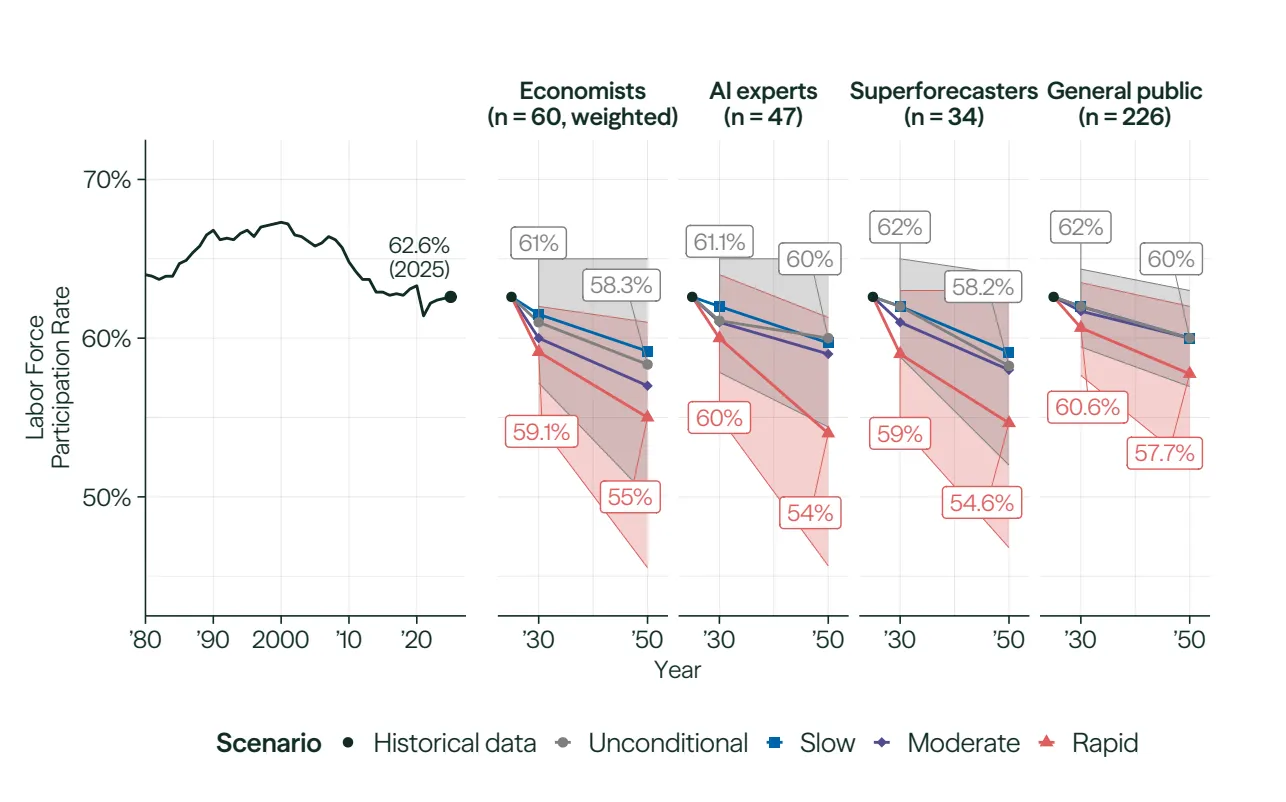
About fractional of that drop, astir 10 cardinal mislaid jobs, would beryllium straight attributable to AI alternatively than demographics oregon different trends.
The accelerated script isn't subject fiction. It's the satellite wherever AI tin negociate publication contracts, assistance successful immoderate mill oregon home, and regenerate each freelance bundle engineers, paralegals, and lawsuit work agents.
Anthropic CEO Dario Amodei has already warned that the disruption is accelerating faster than astir expect—and the study's accelerated script efficaciously validates that framing. GDP tells the different fractional of the story.
Under the aforesaid accelerated scenario, economists task yearly GDP maturation hitting 3.5% by 2045-2049—approaching post-WWII roar levels. AI experts are adjacent much bullish, forecasting 5.3% growth. Tremendous aggregate wealthiness creation, concentrated astatine the top, with a thinner workforce to stock it. The researchers emblem that nether accelerated AI, the wealthiest 10% of households could clasp 80% of full wealthiness by 2050—higher than pre-WWII inequality.
But there's a nuance that often gets mislaid successful the AI jobs debate. The insubstantial finds that adept disagreement isn't chiefly astir whether almighty AI volition arrive, but astir what happens to the system erstwhile it does. That's a meaningful shift. The erstwhile pro-tech arguments assumed that adjacent transformative automation would yet make caller categories of work. The caller question economists are wrestling with is whether AI, dissimilar ATMs, automates the task of inventing caller tasks.
For now, the aggregate employment information inactive looks mostly stable. A Yale and Brookings study from precocious 2025 recovered nary wide unemployment awesome astir 3 years aft ChatGPT's launch. But research cited successful the caller insubstantial documents a 13% comparative employment driblet among workers aged 22-25 successful the astir AI-exposed occupations. The macro is stable. The starring borderline is not.
On policy, economists and the wide nationalist portion ways sharply. Economists favour targeted retraining programs (71.8% support) and mostly cull occupation guarantees (13.7%) and cosmopolitan basal income (37.4%). The wide nationalist is acold much unfastened to structural interventions. The paper's authors enactment that optimal argumentation depends heavy connected which script plays out—and close now, cipher knows which 1 will.
So, the “augment, not replace” parable isn't dead, but it's connected beingness support, and the economists moving the numbers person capable information to beryllium worried.
Daily Debrief Newsletter
Start each time with the apical quality stories close now, positive archetypal features, a podcast, videos and more.







 English (US) ·